
CPR Saves Lives: Why Immediate Action Matters During Cardiac Arrest
Why Immediate CPR Is the Difference Between Life and Death
Cardiac arrest is one of the leading causes of death in the United States, and it often strikes without warning. A person can appear completely healthy one moment and collapse the next. In those critical first few minutes, survival depends not on a hospital, not on advanced equipment, and not even on emergency responders — but on the people nearby.
Immediate CPR saves lives. And the science is clear.
According to the American Heart Association (AHA), more than 350,000 out-of-hospital cardiac arrests occur each year in the United States. Nearly 70% of these happen at home, meaning a loved one is usually the first person on the scene (American Heart Association, 2023). Without immediate intervention, survival rates are extremely low. But when bystanders step in and begin CPR right away, survival chances can double or even triple.
Understanding why immediate action matters begins with understanding what cardiac arrest actually is.
What Happens During Cardiac Arrest?
Cardiac arrest occurs when the heart suddenly stops beating effectively due to an electrical malfunction. Unlike a heart attack — which is caused by a blockage in blood flow to the heart muscle — cardiac arrest is an electrical failure that causes the heart to stop pumping blood to the brain and vital organs.
When the heart stops:
-
Oxygenated blood no longer circulates.
-
The brain is deprived of oxygen.
-
Brain injury can begin within 4–6 minutes.
-
Death can occur within minutes without intervention.
The National Heart, Lung, and Blood Institute confirms that irreversible brain damage can begin after about four minutes without oxygen (NHLBI, 2022). Emergency medical services (EMS) response times vary, but the national average often exceeds that four-minute window. That means survival frequently depends on what happens before paramedics arrive.
This is where CPR becomes critical.
How CPR Keeps the Brain Alive
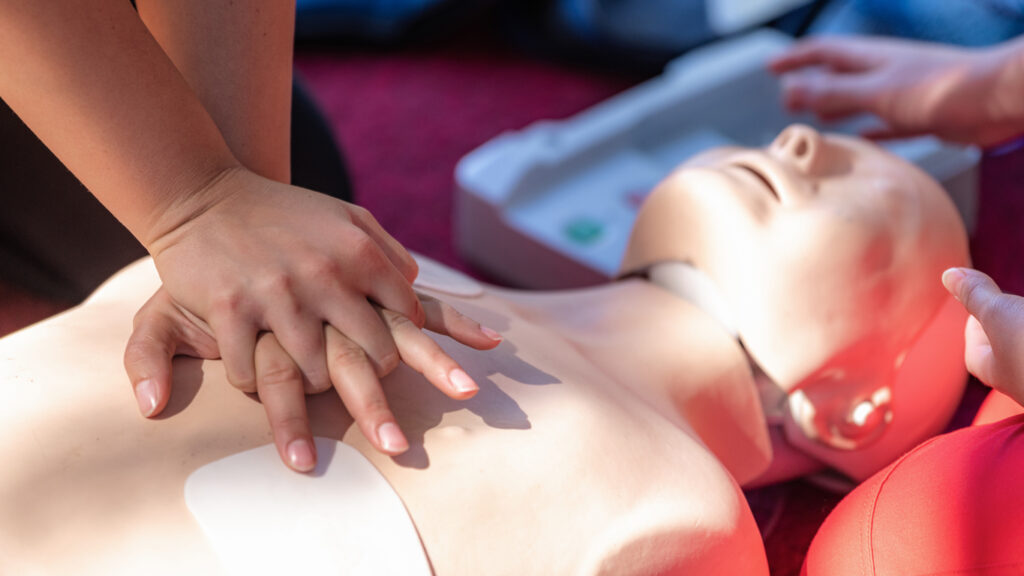
Cardiopulmonary resuscitation (CPR) works by manually circulating blood through chest compressions. Each compression acts as a mechanical pump, forcing blood from the heart to the brain and other vital organs. While CPR does not restart the heart on its own, it preserves organ function long enough for advanced care and defibrillation to restore a normal rhythm.
The American Heart Association reports that for every minute without CPR, survival decreases by approximately 7–10% (AHA, 2020). After 10 minutes without intervention, survival becomes extremely unlikely.
However, when high-quality CPR is started immediately, the odds change dramatically. Research published in Circulation, the AHA’s flagship journal, demonstrates that bystander CPR is associated with significantly improved neurological outcomes and survival rates (Hasselqvist-Ax et al., 2015).
In simple terms: CPR buys time. And in cardiac arrest, time is everything.
The Critical Role of Early Defibrillation
While CPR maintains circulation, many cardiac arrests are caused by ventricular fibrillation — a chaotic heart rhythm that requires an electrical shock to reset. This shock is delivered by an Automated External Defibrillator (AED).
AEDs are designed to be used by the public. They provide voice prompts, analyze heart rhythm automatically, and only deliver a shock if necessary. When CPR is combined with early defibrillation, survival rates increase dramatically.
The AHA emphasizes the “Chain of Survival,” which includes early recognition, early CPR, rapid defibrillation, effective advanced life support, and integrated post–cardiac arrest care. Weakness in any link reduces survival. Immediate bystander CPR strengthens the entire chain (American Heart Association, 2023).
Communities with widespread CPR and AED training consistently show higher survival outcomes. This is not theoretical — it is measurable public health data.
Why Bystander Action Makes the Difference
Despite the proven effectiveness of CPR, bystander intervention rates remain lower than they should be. According to the Centers for Disease Control and Prevention (CDC), approximately 40% of out-of-hospital cardiac arrest victims receive bystander CPR (CDC, 2022). That means more than half of victims may not receive immediate help before EMS arrival.
The reasons people hesitate are often rooted in fear: fear of doing it incorrectly, fear of causing harm, or fear of legal consequences. Yet Good Samaritan laws in all 50 states provide legal protection to individuals who act in good faith to provide emergency assistance.
Perhaps more importantly, the risk of doing nothing is far greater than the risk of imperfect CPR.
Hands-only CPR — chest compressions without rescue breaths — has been shown to be highly effective in adult sudden cardiac arrest cases. The AHA recommends pushing hard and fast in the center of the chest at a rate of 100–120 compressions per minute until help arrives (AHA Guidelines Update, 2020). Even simplified instruction significantly increases intervention rates and survival outcomes.
Training removes hesitation. Confidence replaces fear. And confidence is built through practice.
Cardiac Arrest Can Happen Anywhere
One of the most dangerous misconceptions about cardiac arrest is that it primarily affects elderly individuals or people in hospitals. In reality, cardiac arrest affects adults of all ages and even young athletes. Structural heart abnormalities, electrical disorders, drowning incidents, trauma, and underlying medical conditions can all trigger sudden cardiac arrest.
Because nearly 70% of cases occur in residential settings, family members are often the first and only immediate responders (American Heart Association, 2023). Cardiac arrest also occurs in schools, fitness centers, workplaces, aquatic facilities, and community spaces.
For aquatic environments in particular, oxygen deprivation events — including drowning — can quickly lead to cardiac arrest. Rapid recognition, immediate CPR, and AED deployment are essential in these settings.
Prepared communities save lives. Unprepared communities lose them.
The Neurological Factor: It’s Not Just Survival — It’s Quality of Survival
Survival alone is not the only outcome that matters. Neurological recovery is equally critical. Brain cells begin to suffer injury quickly without oxygen, and prolonged downtime can lead to permanent cognitive impairment.
Studies indicate that early CPR significantly improves the likelihood of survival with favorable neurological function (Hasselqvist-Ax et al., 2015). In other words, immediate action doesn’t just increase the chance of living — it increases the chance of returning to a normal, functional life.
This distinction is powerful. CPR is not simply about extending life; it is about preserving brain health and protecting long-term quality of life.
Training Creates Readiness
Knowledge alone is not enough in an emergency. Stress narrows focus and impairs decision-making. Training creates muscle memory. When compressions have been practiced repeatedly, the body responds automatically.
High-quality CPR training reinforces:
-
Proper compression depth and rate
-
Minimizing interruptions
-
Effective AED use
-
Team coordination during emergencies
Practical, hands-on experience builds competence. Competence builds speed. And speed saves lives.
Communities that prioritize CPR certification empower ordinary people to become immediate responders. Parents protect children. Coaches protect athletes. Coworkers protect one another. Lifeguards and aquatic professionals reinforce existing safety systems with advanced readiness.
The impact extends beyond a single individual — it strengthens an entire community’s resilience.
Immediate Action Is a Choice
Cardiac arrest is sudden. It is frightening. It is chaotic. But it is also survivable — especially when someone nearby is trained and willing to act.
The difference between tragedy and survival often comes down to a single decision made in the first minute: begin CPR or wait.
The science is clear. Immediate CPR can double or triple survival rates. Each minute without action decreases survival by up to 10%. Brain injury begins within minutes. Bystander intervention improves neurological outcomes. Early defibrillation restores life-saving heart rhythms.
CPR saves lives because it preserves oxygen flow during the most critical window of time.
Prepared individuals become lifesavers. And lifesavers strengthen entire communities.
References
American Heart Association. (2023). Heart Disease and Stroke Statistics Update.
American Heart Association. (2020). CPR & ECC Guidelines Update.
Centers for Disease Control and Prevention (CDC). (2022). Out-of-Hospital Cardiac Arrest Data.
National Heart, Lung, and Blood Institute (NHLBI). (2022). What Is Cardiac Arrest?
Hasselqvist-Ax, I., et al. (2015). Early Cardiopulmonary Resuscitation in Out-of-Hospital Cardiac Arrest. Circulation, 132(16), 1530–1538.
Our Affiliates