1-844-THE-SWAN
WE'RE OPEN
1-844-THE-SWAN
If you manage a warehouse, a school, a gym, an office, or a job site, you have probably asked some version of this question: Are we actually required to have people trained in CPR and first aid? The answer depends on your industry and your setup, but for most employers the short version is this: OSHA expects you to be ready for a medical emergency before help arrives, and trained employees are how most workplaces meet that expectation.
Here is a plain-language look at what the rules say, where employers commonly fall short, and how to build a program that holds up.
The core federal rule is OSHA's first aid standard, 29 CFR 1910.151(b). It says that when there is no infirmary, clinic, or hospital in "near proximity" to the workplace, the employer must have a person or persons adequately trained to render first aid.
"Near proximity" is where many employers get tripped up. OSHA has said in its interpretations that for workplaces where serious accidents such as falls, suffocation, or electrocution are possible, emergency care should be available within about three to four minutes. For lower-risk workplaces, a somewhat longer response time may be acceptable. Either way, a hospital across town usually does not satisfy the rule on its own.
Some industries have standards that go further and specifically call for CPR-trained personnel, including:
In California, Cal/OSHA has its own first aid requirements in Title 8, and many state and local licensing rules for childcare, fitness, and recreation facilities add CPR expectations on top of the federal baseline.
This post is general information, not legal advice. Your safety officer or counsel should confirm the requirements that apply to your specific operation.
A training certificate in a binder checks a box. What actually matters is whether someone on today's shift will step forward and act when a coworker collapses.
Sudden cardiac arrest does not wait for an ambulance. Every minute without CPR and defibrillation lowers the chance of survival, which is why the minutes before EMS arrives are the ones that count. A workplace that is truly prepared has:
In our work with employers, the same gaps come up again and again:
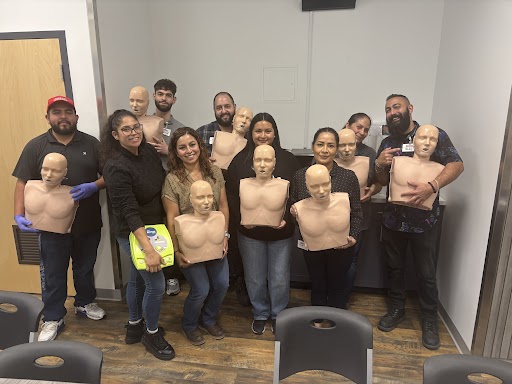
Effective CPR, AED, and First Aid training is hands-on. Employees should practice chest compressions, rescue breaths, and AED use on manikins and trainer units, and walk through realistic scenarios such as choking, bleeding control, and a coworker who goes down in the break room.
Swan CPR is an American Red Cross Authorized Provider, and our instructors bring that same standard to every class. We also offer onsite workplace trainings, so your team learns in the space where an emergency would actually happen. That makes it easier to point out where the AED is mounted, talk through your building's access points, and train a whole shift at once without sending people across town.
If any of those answers are "not sure," that is the place to start.
Swan CPR brings hands-on CPR, AED, and First Aid training to your workplace, on your schedule. Whether you need to certify a handful of supervisors or an entire shift, we will help you build a program that meets your requirements and prepares your people to act.