1-844-THE-SWAN
WE'RE OPEN
1-844-THE-SWAN
Here's an uncomfortable truth about emergencies: when one actually happens, you don't rise to the occasion. You fall to the level of your training.
In a real cardiac arrest — a coworker collapsing at a desk, a swimmer pulled from a pool, a parent slumping at a family barbecue — your heart rate spikes, fine motor skills degrade, and tunnel vision sets in. People who have only read about CPR routinely freeze in this moment. Not because they don't care, but because their body has never done the thing it's being asked to do.
That's the case for hands-on training. Muscle memory is the only skill that survives adrenaline.
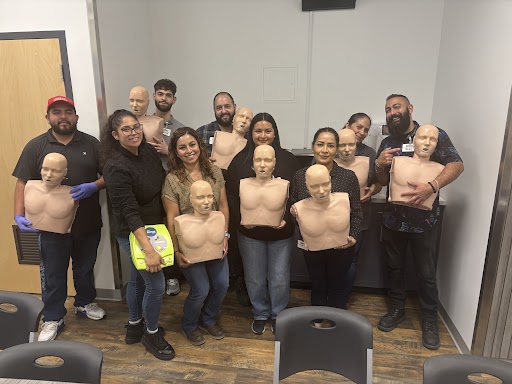
A slideshow can teach you what chest compressions are. Only practice teaches you what they feel like — how deep two inches really is, how fast 100 to 120 beats per minute actually feels after two exhausting minutes, how an AED talks you through its steps while your hands shake.
Effective emergency-response training is built around scenarios, not slides:
Studies of bystander CPR consistently find the same thing: the biggest barrier isn't knowledge, it's hesitation. People are afraid of doing it wrong. Hands-on training closes that gap — you've pushed on a chest before, so you'll do it again. And in cardiac arrest, doing something quickly beats doing nothing perfectly, every time.
Swan CPR courses are taught in person, hands-on, by instructors who respond to real aquatic and workplace emergencies — the same training standards we hold our own professional lifeguard teams to. We train individuals, teams, and entire workplaces in CPR, AED, and First Aid, and we bring the training to you: your office, your facility, your staff room, on your schedule.
When the emergency comes, you won't have time to think. Train so you won't need to. Book a class or a workplace training with Swan CPR today.